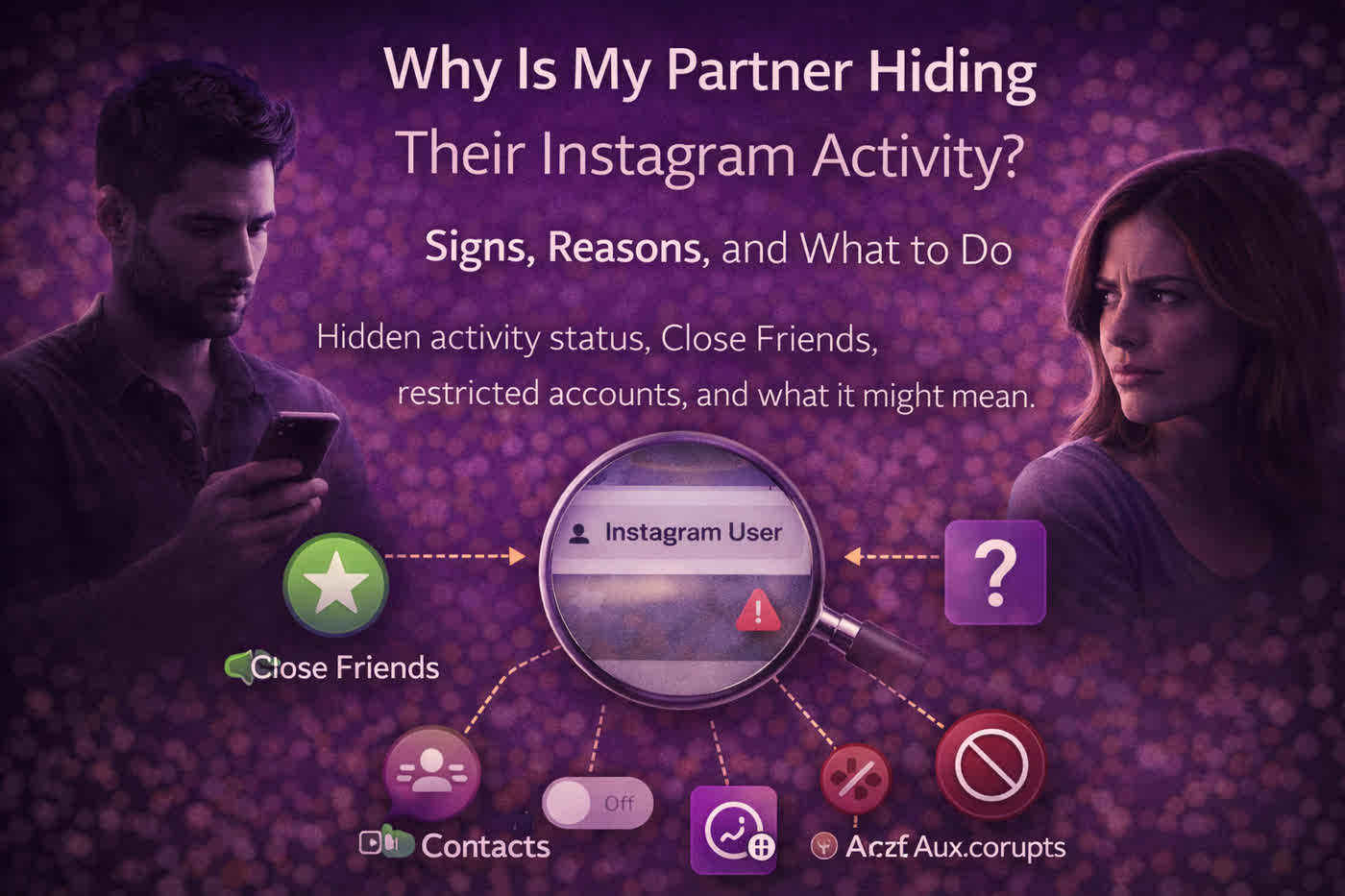
You've noticed your partner turning their phone face down, swiping away notifications, or clearing their Instagram DMs before you walk into the room. That shift in behavior stirs something uncomfortable, and you want to know what it means before you say something you can't take back.
Not every change in phone behavior signals a problem. But some patterns do matter, and knowing the difference saves you from either overreacting to nothing or ignoring something real. This guide walks you through the most common reasons partners hide Instagram activity, the specific behaviors worth paying attention to, and the steps that actually help you address it.
Privacy and secrecy are not the same thing. A partner who keeps their phone locked isn't necessarily hiding something. A partner who deletes DMs every night and removes you from their Close Friends list is showing a pattern worth discussing.
Instagram's features make selective secrecy easy. Stories, Close Friends lists, vanish mode, and DM controls let users decide exactly who sees what. These tools serve legitimate privacy needs, but they also create opportunities for hidden behavior.
Behavioral changes matter more than single actions. One cleared notification means nothing. A cluster of new habits over weeks, like password changes, late-night activity spikes, and emotional withdrawal, tells a different story.
Open conversation is the only approach that protects the relationship. Snooping confirms suspicions but destroys trust. Starting with a direct, non-accusatory question gives your partner the chance to explain before assumptions take over.
Anonymous Instagram viewers let you check public activity without confrontation. Tools like Peekviewer let you view stories anonymously on Instagram to understand what someone is posting publicly before deciding whether a conversation is needed.
A locked phone is not evidence of anything. People protect their devices for the same reason they close the bathroom door: personal space doesn't disappear inside a relationship.
According to the Pew Research Center, 34% of adults report feeling uncomfortable sharing their full digital lives with a partner. That discomfort is normal and doesn't indicate deception. Your partner may simply want to keep work messages, financial apps, or personal group chats private, and none of that reflects on your relationship.
Secrecy is different. Secrecy involves actively concealing specific interactions from you while knowing you'd want to know about them. The distinction matters because it determines whether you're dealing with a healthy boundary or a trust problem.
NOTE: If your partner has always been private about their phone and nothing has changed recently, their behavior probably isn't about you. The concern starts when established patterns shift without explanation.
Instagram gives users granular control over who sees their content. These features exist for legitimate privacy reasons, but they also create easy paths to selective secrecy.
Close Friends list. This controls who sees certain Stories. If your partner removes you from their Close Friends list or starts posting exclusively to it, you'll stop seeing content they're sharing with others. You may not even notice the change unless someone else mentions a Story you never saw.
Vanish mode. Messages sent in vanish mode disappear after they're read and the chat is closed. There's no notification, no record, and no way to recover the content. Instagram designed this for casual conversations, but it also eliminates any trace of a conversation.
Story hiding. Your partner can hide their Stories from specific accounts without blocking or unfollowing them. If you stop seeing their Stories but their account is still active, they may have hidden you from their Story audience.
DM request filtering. Message requests from accounts your partner doesn't follow land in a hidden inbox. These conversations don't generate notifications on the main screen, making them invisible to anyone glancing at the phone.
Understanding how these features work gives you the context to interpret what you're seeing, or not seeing, on your partner's profile.
Single actions rarely mean anything. Patterns do. Here are the behavioral shifts that relationship counselors and researchers consistently flag as worth noticing.
Password changes without explanation. If your partner suddenly changes their phone or Instagram password after previously sharing it, the timing and context matter. A routine security update is different from a change that coincides with other suspicious behavior.
Consistent message deletion. Clearing individual conversations or entire DM histories on a regular basis goes beyond normal phone maintenance. According to one survey on social media behavior, 45% of people who hide messages or social media activity do so specifically to avoid suspicion from a partner.
Late-night activity spikes. Instagram activity that consistently happens late at night, especially when your partner thinks you're asleep, can indicate conversations or interactions they don't want you to see in real time.
Emotional withdrawal paired with phone attachment. When your partner becomes less communicative with you but more attached to their phone, the combination creates a pattern. Either behavior alone could be explained by stress or habit. Together, they suggest attention is being directed somewhere specific.
Defensive reactions to casual questions. If asking "who was that?" about a notification triggers an outsized emotional reaction, your partner may be preempting a conversation they don't want to have.
IMPORTANT: These signs don't prove infidelity or deception on their own. They indicate a behavioral shift that deserves a conversation, not an accusation.
The reasons range from completely harmless to genuinely concerning. Before acting on suspicion, consider which category your partner's behavior most likely falls into.
Some people are naturally private about their digital lives. They don't share passwords, they keep their phone on silent, and they view social media as a personal space. This isn't about you. If this has been your partner's behavior since the beginning of your relationship, it reflects their personality, not a problem.
Your partner might hide activity because they expect you to react badly to something innocent. Messaging a colleague, liking a friend's photo, or following a new account can feel risky if previous conversations about social media behavior ended in conflict. In this case, the hiding is a response to the relationship dynamic, not a sign of wrongdoing.
People use Instagram as an escape from anxiety, boredom, or emotional pressure. If your partner is scrolling through reels at 1 AM, it might not be about hiding something from you. It could be a coping mechanism for managing their own mental state. The American Psychological Association has found that 40% of adults use social media to manage stress.
In some cases, secrecy around Instagram activity points to a relationship outside your own. Research on social media and relationships shows that 32% of people who cheated used social platforms to maintain contact with the other person. Regularly deleting DMs, hiding Stories, using vanish mode, and becoming emotionally withdrawn when questioned are the patterns most consistently associated with infidelity.
This is the outcome everyone fears, but it's not the most common explanation. Exhaust the other possibilities before settling on this one.
Snooping through your partner's phone might give you answers, but it also breaks the trust you're trying to protect. Research from Kaspersky found that 70% of couples who snooped on a partner's phone reported a decline in relationship trust afterward, regardless of what they found.
Here's what works better.
"I've noticed you've been more private with your phone lately, and I wanted to check in" is a different conversation than "I think you're hiding something from me." The first opens dialogue. The second triggers defense.
Tell your partner what you've seen: the password change, the deleted messages, the Stories you stopped seeing. Don't tell them what you think it means. Let them explain before you conclude.
If the conversation goes well, use it as an opportunity to establish shared expectations about digital privacy. Some couples agree to keep phones unlocked. Others agree that certain conversations are private. What matters is that both people consent to the same arrangement.
If your partner's explanations don't match their behavior, or if the secrecy continues after a direct conversation, the issue may be deeper than social media habits. At that point, couples counseling or a more structured approach to the relationship is worth considering.
Before starting a difficult conversation, you may want to understand what your partner is posting publicly, especially if they've hidden their Stories from your account. Anonymous Instagram viewers let you see public Stories, posts, and highlights without your name appearing in their viewer list.
Tools like Peekviewer, a browser-based anonymous Instagram viewer, let you enter a username and view their public content without logging in. You don't need an Instagram account, and the person you're viewing never knows you checked. This gives you a factual baseline before deciding whether a conversation is necessary.
What anonymous viewers can do: View public Stories and highlights, check recent posts and reels, download public content for reference.
What they can't do: Access private accounts, read DMs, or show you who your partner is messaging. No legitimate tool offers this, and any service claiming otherwise is a scam.
Anonymous viewing is a way to gather publicly available information discreetly. It's not surveillance, and it doesn't replace communication. But it can help you separate what you're imagining from what's actually being posted.
Meta recently began testing Instagram Plus, a $1 to $2 per month subscription that includes native anonymous Story viewing. Subscribers in Mexico, Japan, and the Philippines can already watch Stories without appearing in the viewer list.
If Instagram Plus launches globally, it changes the dynamic around Story viewing entirely. Anonymous viewing would shift from a third-party workaround to a built-in feature that anyone can pay for. For people in relationships, this means your partner may eventually be able to view your Stories anonymously through Instagram itself, and vice versa.
For now, third-party tools remain the only option in most countries. But this development is worth watching.
It depends on the pattern. Keeping a phone locked or maintaining some digital privacy is normal and healthy. Actively deleting messages, hiding Stories from your account, or using vanish mode regularly signals a behavior change that's worth discussing.
Snooping tends to damage trust whether or not you find anything. A direct conversation about what you've observed is more likely to lead to a productive outcome. If you want to see what they're posting publicly without confrontation, anonymous Instagram viewers let you check Stories and posts without your name appearing.
Not through your own account. But if their profile is public, you can use an anonymous Instagram viewer like Peekviewer to view their Stories without logging in. This only works for public accounts. Private accounts are locked to approved followers only.
The most consistent signs include regularly deleting DMs, hiding Stories from you, using vanish mode, emotional withdrawal when you ask about their phone, and defensive reactions to casual questions about their activity. These patterns together suggest attention is being directed away from the relationship.
A partner who hides their Instagram activity isn't automatically hiding something wrong. Privacy is a legitimate need, fear of overreaction is a real dynamic, and stress-driven phone use is common. But behavioral patterns that cluster together, like message deletion, Story hiding, password changes, and emotional withdrawal, signal that a conversation is overdue.
Start with what you've observed. Ask without accusing. Set expectations together. And if you need to understand what someone is posting publicly before starting that conversation, anonymous Instagram viewers give you a way to check without leaving a trace.